Effective SEO for AI 
— visibility in ChatGPT, Gemini and Copilot responses 

AI models are becoming the new search engine. Users are increasingly looking for answers without visiting a website — expecting ready-made recommendations from ChatGPT, Gemini or Bing Copilot. AI SEO is a process that prepares your brand to be featured in these answers: through expert content, clear definitions, structures preferred by LLM models, and strengthening domain authority.

Check the SEO price list at AI
Pozycjonowanie w AI

What is SEO in AI?

SEO for AI does not replace traditional search engine optimisation. It is an additional layer that prepares your brand for the way models such as ChatGPT, Gemini and Copilot ‘think’ about the world. Rather than simply competing for rankings on Google, we work to ensure that your knowledge, processes and experience are comprehensible to AI models. With properly designed content, your company can become one of the main sources that AI uses when providing answers and recommendations to users. In practice, this means building knowledge blocks (definitions, FAQs, checklists, case studies) that models can easily ‘incorporate’ into their responses, and strengthening your brand’s authority in the places where AI sources its information.

Content layer

We design content to resemble the perfect answer: clear explanations, specific examples, and well-organised blocks of information.

AI layer

We ensure that AI models can easily ‘interpret’ your expertise: definitions, glossaries, brand-specific processes and reference materials.

Business layer

We translate visibility in AI into tangible results: enquiries, your company being selected in recommendations, and strengthening your reputation as an expert.

OPTIMISE YOUR WEBSITE

AI Visibility is the cornerstone of your brand’s visibility in the new era of search 

Systems such as ChatGPT, Gemini and Copilot are increasingly becoming the first place where users look for information and recommendations. By establishing a brand presence within AI-generated responses, you gain an advantage where traditional SEO falls short — in the realm of generated responses that users treat as ready-made advice.

You’re involved in discussions where decisions are made

AI models answer users’ questions in real time — from shopping advice to choosing a service provider. If your content is tailored to how LLMs work, your brand can be highlighted precisely when there is a genuine need.

You reach users who are looking for a specific solution

Your knowledge becomes part of the AI models' knowledge base

Well-structured content — definitions, explanations, processes, and tables — serves as valuable ‘fuel’ for models. This means your website can become one of the sources on which AI bases its responses.

Your content is starting to function within the AI ecosystem

You’re building a competitive edge in areas where algorithms are still taking shape

SEO in AI is a market with virtually no competition. Implementing a visibility strategy early on ensures that a brand is established in search results before others — and this leads to long-term dominance in a sector that is only just beginning to grow.

You gain a presence that will be hard to beat

MAKE YOUR MARK IN AI

What exactly do we optimise as part of your company’s AI SEO?

Not the ‘magic of artificial intelligence’, but concrete work on how AI models perceive your brand, content and expertise.

Mapping questions and topics

We identify the questions users ask AI in your industry – from seeking advice to choosing a supplier. Based on this, we plan where your brand should appear in the answers.

Content structures for LLM models

We design definitions, FAQs, checklists and process descriptions in a format that models can easily ‘read’: short blocks of information, clear headings and logical steps, rather than rambling on.

Knowledge hub and expert glossaries

We are building an encyclopaedia for your brand: glossaries, mini-guides and reference articles that can serve as a reference point for AI when generating responses.

Content distribution within the AI ecosystem

We embed key content in a variety of places: on the website, in PDFs, articles and expert resources. This ensures that candidates are exposed to your expertise from a range of sources.

Strengthening authority and brand tokens

We design process names, methodologies and case studies that AI can associate with your company. This increases the likelihood of your brand being identified as an expert in a given field.

Monitoring AI responses and corrections

We regularly test ChatGPT, Gemini and Copilot’s responses to a set of queries. Based on this, we refine our content and strategy to ensure the brand is mentioned more and more often.

POSITION YOUR COMPANY IN AI

SEO in AI works differently from traditional search engine optimisation

Google organises results in the SERP, whilst AI models generate a ready-made answer. A different mechanism = a different strategy, different priorities.

Area SEO in AI Classic SEO​Klasyczne SEO
Main objective Ensure that the brand is mentioned in the models’ responses as a source of knowledge and recommendations – even without clicking on the result Rank highly in Google search results and increase organic traffic to your website.
How it works Models combine knowledge from a variety of sources to produce a single answer. What matters is the clarity of the content, the definitions, the diagrams and the consistency of the messages. The algorithm evaluates each subpage individually based on links, content, technical factors and user behaviour.
What is being optimised? Knowledge modules: FAQs, definitions, checklists, case studies, glossaries, and branded processes. Content designed for LLM language. Category pages, articles, product descriptions, metadata, website structure, internal linking and backlink profile.
Key signal How closely the content resembles the ideal answer: comprehensiveness, a neutral tone, practical examples, and a clear structure.​  Keyword relevance, domain authority, PageSpeed, UX, backlink profile and user behaviour in search results.
The benefit for the company The brand comes up in conversations where decisions are made. The user receives your company as a ready-made recommendation. More traffic from Google, more website visits and leads from organic search results.
POSITION YOUR COMPANY IN AI

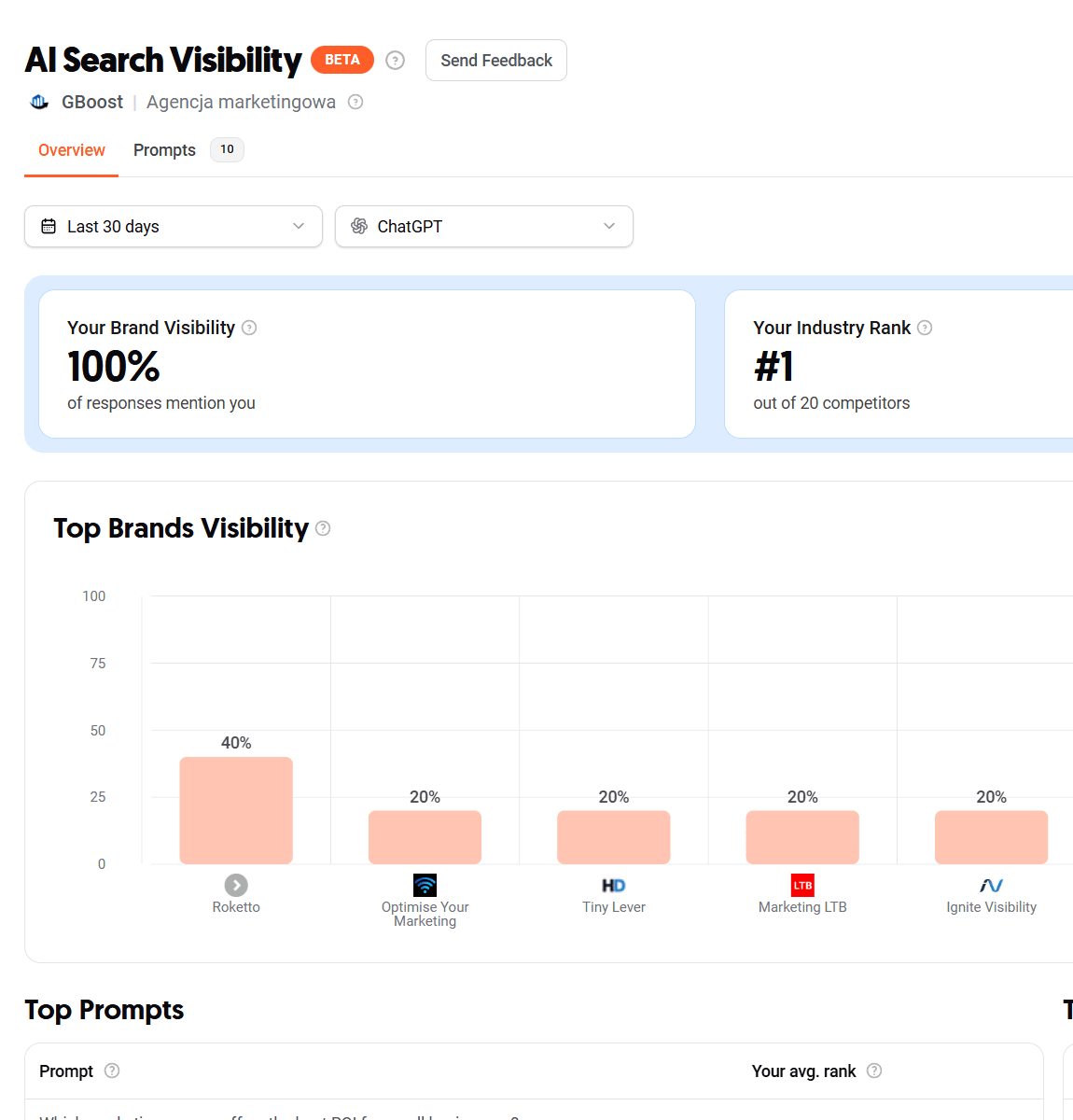
How we measure visibility in AI responses

Visibility in AI isn’t just about whether your domain appears in search results. What matters to us is whether the models actually ‘associate’ your brand with a given topic and whether they can suggest it to the user as a solution.

That is why, rather than focusing solely on Google rankings, we analyse the responses from ChatGPT, Gemini, Copilot and AI Overview to a set of prepared questions. Based on this, we assess your brand’s presence in conversations driven by artificial intelligence.

  • Set of test questions. We compile a list of realistic queries from your industry – informational, expert-based and recommendation-based – that users might ask the AI.
  • Analysis of model responses. We check whether and how your brand and competitors are mentioned in the responses, and what arguments the AI puts forward.
  • Analysis of the context of the mention. We assess whether the brand is mentioned as an example, one of many solutions, or as a specific recommendation for action.
  • AI Visibility Score™ and conclusions. Finally, you receive a summary score and descriptive recommendations on what to do to increase the brand’s presence in AI responses.
EXTENSION OF CLASSIC SEO

First, a strong SEO foundation.
Then visibility in AI answers.

AI models do not “pull” a brand out of nowhere. They build answers based on content, links and signals from across the web — exactly what we develop through classic SEO work.

That is why we treat AI SEO as an additional visibility layer. It makes the most sense when your website is already visible, technically structured and trusted by Google.

How do we approach it?

  • Step 1 — SEO. Audit, technical SEO, content, links and Google visibility.
  • Step 2 — AI SEO. We check how AI models understand your brand and where it appears in answers.
  • Step 3 — Growth. We optimize content and signals so AI tools are more likely to recommend your company.

We recommend starting with standard SEO positioning or choosing a combined SEO + AI SEO package.

Pricing AI SEO

Packages can be combined with classic SEO or implemented step by step. The scope is indicative — we adjust it to your industry, market and visibility goals.

LOCAL START

AI Start

A basic package to check whether and how AI models see your brand, without a large initial commitment.

Small businesses / local servicesInitial AI visibilityExtension of classic SEO
100 €/ month excl. VAT
  • Analysis of up to 20 industry-related questions asked in AI models.
  • Brand visibility testing in ChatGPT and Gemini.
  • Monthly AI Visibility Score™ report with key findings.
  • 2 content recommendations per month for AI visibility.
  • Optimization of 1 key subpage for AI-friendly content.
MOST POPULAR

AI Growth

Extended AI model analysis and ongoing optimization to make your brand appear more often in recommendations.

Service companies and online storesOngoing AI visibility growthEU market support
170 €/ month excl. VAT
  • Analysis of up to 50 questions: informational, expert and recommendation-based.
  • Testing in 4 models: ChatGPT, Gemini, Copilot and Google AI Overview.
  • Full AI Visibility Score™ report once per month.
  • Optimization of 3 subpages per month for AI and brand signals.
  • Up to 6 short AI-content micro-articles per month.
  • Basic competitor monitoring in AI answers once per month.
FOR MARKET LEADERS

AI Authority

For brands that want to be recommended by AI as leading experts in their category across local and international markets.

Strong brands and expert websitesOnline stores with larger trafficLocal + international markets
290 €/ month excl. VAT
  • Analysis of 100+ questions and AI conversation scenarios.
  • Testing in advanced AI models: ChatGPT, Gemini, Copilot and Google AI Overview.
  • AI Visibility Score™ report every 2 weeks with trend comparison.
  • Optimization of 6 subpages per month and development of an AI Knowledge Hub.
  • Up to 10 expert AI-content micro-articles per month.
  • Extended competitor and brand signal monitoring.

AI SEO is not magic,
it is analysis that can be measured.

AI models build answers based on content, links and signals from across the web. Our role is to check whether your brand appears in those answers, how it is presented and what needs to be improved to make it recommended more often.

As part of AI SEO, we analyze visibility in tools such as ChatGPT, Gemini, Copilot and Google AI Overview. We review customer questions, mention context and recommendations, then turn the findings into specific content and SEO signal recommendations.

AI SEO works best as an extension of classic SEO. If your website does not yet have a solid foundation in Google, we recommend starting with SEO positioning or running both areas in parallel: SEO + AI SEO.

Step 1
Step 2
Step 3
Step 4
Selected package
AI Start
Entry-level package for checking whether and how AI models see your brand.

Frequently Asked Questions

What exactly is SEO in AI, and how does it differ from traditional SEO?

SEO in AI involves optimising how your brand appears in the responses of models such as ChatGPT, Gemini, Copilot and Google AI Overview – in other words, wherever a user receives a ready-made answer rather than a list of links. Traditional SEO focuses mainly on visibility in Google’s search results (TOP3, TOP10, sections such as maps and ‘people also ask’). In AI SEO, we take a broader view: we analyse whether your brand is mentioned at all in AI responses, in what context, how it compares to the competition, and how content from your website, guest articles, reviews and other sources influences what the model “recommends” to the user. The key is to combine both areas – solid on-site and off-site SEO foundations plus the deliberate creation of signals that AI can use in its responses.

Does SEO for AI make sense if my traditional SEO is still poor or I’m not doing any at all?

It is possible to carry out a one-off SEO audit for AI, but without a solid SEO foundation on Google, the results will be limited. AI models rely on what they find online – if your website ranks poorly, has little content, few mentions and few links, then in the ‘eyes’ of AI you simply do not exist or are considered unreliable. That is why we treat SEO for AI as an extension: first, a solid foundation (technical aspects, content, links), and only then intensive efforts to improve visibility in AI responses. In practice, we often combine both processes – we improve traditional SEO whilst simultaneously designing activities that increase the likelihood of your brand appearing in the models’ responses.

Which industries benefit most from AI-powered SEO?

The sectors that benefit most are those where users ask complex questions and expect expert, trustworthy answers – law, finance, medicine and healthcare, specialist services (e.g. audits, thermal imaging, technical inspections), B2B, training or SaaS solutions. In such segments, AI often constructs long, guide-style answers and readily points to specific brands as examples or recommendations. SEO in AI also works well in e-commerce, particularly where customers are comparing options (“what to choose…?”, “which service/product for…?”). For very simple, impulse purchases (e.g. a cheap product from a marketplace), the impact of AI is smaller, but it is still worth ensuring a consistent brand image and credibility across the entire search ecosystem.

How do you measure SEO results in AI, given that there are no ‘positions 1–10’ as there are on Google?

Instead of looking solely at ranking, we analyse several layers:
• whether the brand appears at all in the answers to users’ key questions,
• in what context it is mentioned (neutral, positive, expert, comparative),
• whether the model lists your brand as one of the main recommendations,
• how often – in tests with different query variants – you are mentioned in comparison to the competition. 

On this basis, we build visibility metrics in AI (share of responses, share of recommendations, reach of queries in which you appear). Additionally, we measure the impact of changes on organic traffic and queries from traditional SEO – because ultimately, what matters is whether the number of valuable leads and sales is growing.

Is SEO in AI a ‘black box’, or is it actually possible to influence the models’ responses?

AI models are indeed complex, but they are not entirely random. They are based on data: the content on your website, external publications, expert articles, reviews, citations, links and the domain’s overall reputation. Our job is to organise these signals:improving content structure so that AI can use it more easily (clear headings, FAQs, case studies, company data),building credible external sources (articles, expert statements, testimonials),standardising brand communication so that models ‘see’ a consistent image of an expert on a given topic. We don’t ‘hack’ models or use tricks that work for a week – we build lasting signals that increase the chance that AI will choose your brand as a credible source.

What does the step-by-step process for AI’s SEO service look like?

We usually divide the process into four stages:
1. Audit – we assess the condition of your website, its content and visibility on Google, and run a series of tests using AI models (ChatGPT, Gemini, Copilot, AI Overview). We examine whether and how you are mentioned, and which brands dominate your category.Opportunity map – we identify the key queries for which you want to be found, and we design a list of content and online locations that need strengthening.
2. Implementation – we supplement or revamp content, recommend off-site activities (publications, mentions, case studies), and if you’re running traditional SEO, we align changes with your existing strategy.
3. Monitoring and adjustments – we regularly repeat AI tests, check how your brand’s visibility has changed, and optimise our next steps. In the long term, the aim is to become one of the default recommendations in your category.

Is SEO on AI safe and compliant with search engine guidelines?

Yes, our working model is 100% based on building quality and credibility, rather than on ‘tricking’ algorithms. We focus on E-E-A-T (Experience, Expertise, Authoritativeness, Trust):
- we showcase real-world experience (case studies, project examples, client testimonials),
- we develop expert content authored by specialists,we ensure consistent company data (name, address, VAT number, social media, publications),
- we avoid mass, artificial linking or content generation. 

As a result, SEO activities in AI support the brand’s overall online reputation and also assist with traditional SEO, rather than creating the risk of penalties or ranking drops.

How quickly can you see the results of SEO in AI?

You get an initial overview of the situation following the audit – usually within a fortnight of the start, we can show you how your brand appears ‘through the eyes’ of various AI models and which areas require the most urgent attention. Changing the AI responses themselves can take time: some models update their knowledge less frequently (snapshot-based versions), whilst others use a live network. In practice, the first positive signs (better response context, the brand appearing in recommendations) are usually visible within a few weeks to a few months, depending on the scale of the changes implemented and the competitiveness of the market. A long-term approach is key, just as it is in traditional SEO.

Does AI-driven SEO make sense for a smaller local business, or is it more of an ‘enterprise’ service?

Small local businesses can also benefit – particularly in niche markets where customers are looking for specific, trusted specialists (e.g. local law firms, technical specialists, research, diagnostics, business services). In such cases, AI often tries to suggest specific solutions ‘close to the user’, and a well-structured brand profile and expert content can give you an edge over larger but less specialised players. The difference lies mainly in the scale of operations: for smaller companies, we focus on a narrow range of services and a few key search queries, rather than ‘attacking’ the entire category globally.

What will I receive from you at the end – a report, recommendations or ongoing support?

It depends on the package you choose. With the basic option, you receive a detailed SEO audit report in AI:a list of search queries for which your brand should appear,test results for individual models (with example responses),a list of recommended on-page changes (technical and content-related),suggestions for off-page activities (publications, strengthening expert profiles, presence on key platforms). In the higher-tier packages, we also take care of implementing the changes and ongoing monitoring – we regularly test AI responses, refine content, and respond to changes in algorithms and model updates. As a result, SEO in AI is not a one-off report, but a real, continuous channel for building brand visibility.

Find out more about SEO

Contents: 
1. How does AI collect and interpret data?
2. AI Visibility vs traditional SEO
3. What makes a brand ‘credible’ to models?
4. External links and SEO
5. How can you measure brand visibility in AI?
6. Content that AI actually uses
7. Why does technical SEO also affect AI?
8. The future of search in the age of AI

How does AI collect and interpret data?

Generative models and AI chatbots analyse the internet in a completely different way to traditional search engine algorithms. In traditional SEO, Google assesses page structure, linking, technical optimisation, keywords and domain authority. In contrast, in AI SEO, what matters most is understanding the subject matter and the coherence of knowledge, rather than individual ranking signals. Models do not index a page line by line — they map meaning, creating internal ‘concept maps’ of interrelated topics, brands and issues. This enables chatbots to generate synthetic responses, based not on copy-paste, but on interconnected concepts drawn from many different sources.

For this reason, SEO for AI requires content that is richer, more comprehensive and more substantive than a standard SEO article. Every piece of content should address users’ real-world problems, explore topics ‘in depth’ and present specific examples and experiences. Models place a very high value on E-E-A-T: expertise, authoritativeness and trustworthiness. If the text on the page is superficial, lacking in substance or written solely to target specific keywords, AI will not consider it a valuable answer and will not recommend the brand in its results.

The second major area is the sources from which AI learns about the brand. Models often draw data from widely available content: the company website, expert blogs, reviews, industry articles, Q&As, PR publications, forum responses, as well as signals indicating the company’s genuine experience. Their aim is to understand whether a given brand actually exists, whether it provides expert knowledge, and whether it can be trusted to answer a user’s query. This is why building a consistent online presence is so important in AI SEO — not just website optimisation, but also expert publications, guides, case studies and external context. The models draw on a variety of sources and compare them to assess who is credible on a given topic.

In practice, this means one thing: your content must be the best possible answer across the entire topic ecosystem, not just better than the competition for phrase X. AI doesn’t show ten links — it selects one answer that is the most relevant, comprehensive and reliable. That is why the role of SEO in AI is to create content that models deem to be of maximum value, logically coherent and based on real-world experience. This is the foundation of visibility in chatbots, conversational search engines and generative response systems.

AI SEO vs Traditional SEO

Visibility in AI operates according to different principles than traditional website optimisation — and this is the most important difference that every business implementing AI SEO needs to understand. On Google, it’s a combination of signals that counts: link quality, technical optimisation, content structure, keyword profile and domain authority. Meanwhile, AI Visibility focuses not on ‘rankings’, but on the model’s ability to quote, summarise or interpret your brand as the best source of answers. Chatbots do not display positions 1–10. They generate a single, coherent answer — which is why the competition is not about securing a spot in the SERPs, but about establishing yourself in the model’s consciousness as an expert on a given topic.

The biggest difference lies in how content is evaluated. Traditional SEO rewards structural correctness and keyword relevance, whereas AI visibility increases when content demonstrates a high level of E-E-A-T and is used within the model’s contexts: comparative questions, long-tail queries, user problems, and thematic analyses. This is why brand and topic-related phrases must appear naturally in many places — AI evaluates not only the website, but also how often the brand appears in discussions about a given category. For example: if a company publishes comprehensive guides, case studies and answers to real customer problems, the models associate it more quickly with a given topic, which increases the chance of being cited in the results.

The second difference is how AI analyses content in the long term. Models do not ‘update rankings’ like Google does from time to time — they build their answers on a dataset that is constantly growing. That is why AI Visibility works like a reputation-building process: the more high-quality content you provide, the more frequently your brand appears in credible sources, and the more clearly your expertise and authority are demonstrated — the more the models treat you as a reliable and competent answer. This is precisely where traditional SEO and AI SEO converge into a single system: a well-ranked website makes it easier for models to discover content, whilst strong visibility in AI reinforces the brand’s overall authority online.

What makes a brand “trustworthy” in the eyes of models?

For AI models, “trustworthiness” is not a single metric — it is a complex combination of signals that collectively paint a picture of the brand as an expert that can be cited in responses. In traditional SEO, domain authority, backlinks and proper optimisation are sufficient, whereas in AI SEO, what matters most is whether the brand consistently delivers value to the user and whether its content helps solve real-world problems. Language models analyse, amongst other things: thematic consistency across the entire ecosystem, depth of knowledge, quality of examples, publication history, consistency of expert language, and how clear and substantive the content is. If a company addresses a single topic just once, briefly and superficially, AI will not recognise it as an expert. However, when content is consistent, comprehensive and maintains thematic continuity, the models begin to treat the brand as a strong reference point.

Credibility is also built by presence in external sources. Models are not limited to the website itself — they also take into account articles on industry portals, reviews, expert publications, research findings, media mentions, company profiles, and activity on channels that are widely available online. This means that if your company is actively involved in industry discussions, publishes case studies, gives interviews, attends conferences or produces specialist reports, AI begins to perceive it as a reliable source of knowledge. Such signals are particularly important for complex phrases requiring interpretation, e.g. “how to improve visibility in AI”, “how SEO affects chatbots” or “why models don’t mention my brand”.

Structural and technical data also play a key role, as models use them to confirm a brand’s identity. This includes consistency in names, business descriptions, categories, NAP (name–address–phone), as well as correct markup such as Organisation Schema, FAQ Schema and Article Schema. AI models use these as signposts: it then becomes easier for them to associate the brand with a specific topic, service or problem. This means that AI positioning requires a combination of expert content and technical organisation — so that the model can unambiguously identify who you are and why your content is valuable.

Most importantly, however, credibility for models is built over time. AI does not trust websites that appear and disappear.

 It looks for stable, consistent and long-term signals. That is why AI SEO is a process in which a brand builds its position through regularity, predictability and substance. If content systematically explores a topic in depth, and the brand does not change its narrative every few moments, chatbots begin to cite it more readily, more directly and in contexts of higher value.

External mentions and AI-driven SEO

In traditional SEO, external mentions are mainly treated as part of link building. In AI-driven SEO, their role is much broader, because models do not just look at the link — they analyse the context, the tone of the statement, the authority of the source, and the consistency of brand information. Every mention on the internet can serve as a signal to the model confirming that the company actually exists, operates in a given industry, and is associated with a specific range of services. As a result, external mentions not only increase the domain’s authority but also strengthen the ‘concept map’ that AI builds around the brand. The more consistent, substantive and positive references there are, the greater the chance that the chatbot will recognise the company as a reliable source of answers.

Models analyse not only major portals but also industry websites, specialist directories, academic publications, PR articles, customer reviews and user-generated content. If the same information appears in multiple places — regarding expertise, results, services, categories of activity or experience — AI treats this as “social verification of knowledge”. This is precisely why creating valuable content in external sources, such as expert articles, industry reports, case studies or responses on specialist forums, has a huge impact on AI Visibility. The models do not want to cite anonymous brands; they want to cite those that operate in the public sphere and provide real value.

An even stronger signal is provided by contextual mentions, where the brand appears alongside topics with which it wishes to be associated. If a company specialises in SEO, and industry websites feature content such as ‘SEO specialists’ analysis’, ‘SEO experts comment’ or ‘ranking of the best SEO strategies’, the models begin to associate that brand with a specific field. The same applies to services such as AI-based SEO, where a presence alongside topics such as innovation, chatbots, visibility in LLMs or content optimisation for language models reinforces the brand’s position as an expert. For AI, what matters is whether the brand actually features in discussions about a given issue.

It is worth remembering that external mentions act as a reputation network. When models see that a brand is mentioned repeatedly across many credible sources, it becomes a natural candidate for citation in responses. This is why companies that actively cultivate expert publications often gain an advantage in AI Visibility — models see not just the website, but the entire ‘reputation ecosystem’, which confirms that the brand is trustworthy.

How to test brand visibility in AI?

Measuring visibility in AI is completely different from monitoring rankings in traditional SEO. There is no single universal ‘AI ranking’, as chatbots do not display a list of results — they generate a single response which, according to the model, is the most relevant, complete and safe. Therefore, testing visibility in AI involves analysing whether the model recognises your brand at all, whether it can identify it as a solution to a problem, and whether it quotes elements from your website or expert content. It is a qualitative, not a quantitative, process. The basis is manually asking questions in various AI tools (ChatGPT, Gemini, Perplexity, Claude) and observing how the models react to mentions of the brand, the offering, and industry topics. If your company does not even appear in contextual responses, it means that the model does not yet recognise you as a reliable source.

The second element of testing is analysing how the models behave in relation to thematic content. In AI Visibility, whether the chatbot understands your specialism is just as important as brand visibility. In practice, this means checking how the model responds to typical customer queries, such as “how to increase visibility in AI?”, “how does SEO work in AI?”, “how to implement SEO in AI for service-based businesses?”, and even detailed industry-specific questions. If the models start using terms that appear in your content — or describe a process in a way that mirrors your strategy — this is a very good sign that the content is beginning to influence their “operational context”.

In practice, it’s worth running tests systematically — e.g. once a month — and checking for changes following the publication of new content, case studies or external mentions. Models learn over time, so results don’t appear immediately. A very strong sign of success is when AI starts mentioning your brand as an example, a recommendation or one of the possible solutions — even if it does so cautiously and indirectly. This is a sign that your AI SEO strategy is working and that your brand is gaining a reputation as an expert within the model’s semantic network.

Content that AI actually uses

Generative models do not treat content like Google does — they are not interested in text length, keyword density or the number of headings. What they are looking for is material that allows them to build knowledge, i.e. content that is comprehensive, coherent, based on real-world experience and presented in a way that can be easily ‘processed’ into an answer for the user. That is why, in AI-driven SEO, the most important thing is to create content that explores a topic from the ground up through to practical applications: step-by-step guides, problem analyses, comprehensive Q&As, case studies, checklists, process documentation, comparative studies, or thematic ‘knowledge hubs’. Models learn particularly well from content that clearly explains why something works, how it works, and what the consequences of bad decisions are. This is why brands publishing “empty” SEO articles are practically non-existent in AI responses — the models cannot make use of them.

Content that supports E-E-A-T – that is, real-world experience and practice backed up by examples – also has a huge advantage. When you publish material that shows your work process, concrete results, error analysis, tests and methods – AI begins to see your brand as a genuine source of knowledge, rather than just another site spouting generalities. In the context of AI SEO, content that demonstrates your expertise through detailed explanations of algorithms, technical analyses, challenges you have successfully resolved, and step-by-step process descriptions is particularly effective. Models heavily reward consistent expert patterns because they are ‘safe’ for them — they can quote or paraphrase your knowledge, knowing it comes from a logical, structured framework.

It is also worth remembering that AI chatbots interpret content semantically, meaning they analyse intent, context, subject matter and internal links. This means that a single article is rarely enough. Models want to see an entire “knowledge cluster” — a set of materials that form a coherent whole. For example, if you’re creating a section on SEO for AI, you’ll need articles on: visibility in AI, building credibility, data analysis, reputation signals, optimising content for models, and even ethics and security. Only such a comprehensive set of materials will ensure that AI treats your brand as a complete expert, rather than a random author of a single piece of content.

Why does technical SEO also affect AI?

Although it may seem that technical SEO is the domain of traditional search engines, in reality it also forms the foundation for AI ranking. Generative models do not ‘crawl’ the internet in the same way as Google, but instead use data that has previously been indexed, processed or collected into so-called training corpora. If your website is technically substandard — with indexing errors, messy HTML structures, a lack of consistent structured data, accessibility issues or inconsistent language versions — the models receive a signal that the content is difficult to interpret and not entirely trustworthy. As a result, even if the content is excellent in substance, AI may not use it in its responses.

The most important elements are those that help models identify content and understand what is what on the page. Structured data types such as Organization, Article, FAQ, BreadcrumbList, Person, Service or HowTo help AI organise content into coherent knowledge schemas. If a website has logical URLs, a well-organised architecture, a clear division of categories, consistent headings and clean code — models find it much easier to ‘read’ its meaning. It is no coincidence that brands with a high level of technical SEO appear much more frequently in AI responses: models intuitively treat them as a more reliable information source.

Technical SEO also influences reputation perception. Models interpret signals regarding consistency: the same name, the same offering, the same industry and the same contact details across the entire internet. If a website has different versions of metadata, numerous conflicting descriptions of its activities, incorrect information about services, or incomplete social media profiles — AI cannot unequivocally determine who you are and what you specialise in. In LLM methodology, uncertainty = reduced visibility, as the model prefers to avoid citing a brand that may be an incorrect or misleading source.

Ultimately, technical SEO and AI SEO work like two interconnected vessels. A technically sound website is easily ‘readable’ by both Google and generative models. This is precisely why AI ranking strategies so often emphasise the importance of: page speed, Core Web Vitals, clean structures, well-organised code, and consistent structured data. The less technical chaos there is, the greater the chance that your content will be incorporated into the “mental model of the world” that AI uses in its responses.

The Future of Search in the AI Era

The direction in which search is heading is already clear: users expect instant, contextual and personalised answers — and that is exactly what generative models deliver. In the coming years, AI search optimisation will become just as important as traditional SEO, and in some industries even more so. Chatbots are taking over the role of the first point of contact with information, and conversational search engines are gradually replacing traditional lists of links. Users will not type in “the best SEO agency in city X”, but will ask: “Which company is best at SEO for e-commerce?” or “What is the best solution for my situation?” — and expect a single, simple, tailored answer. This fundamentally changes the way we think about visibility.

For brands, this means the need to build broader reputational capital, rather than simply carrying out activities “to please the algorithm”. Models will increasingly analyse the consistency of signals, content history, coherence of communication and authenticity of experience. Companies that start investing in substantive content, case studies, educational processes, transparency and data-driven publications will gain an advantage that cannot be made up for with quick SEO tricks. In a sense, SEO in AI rewards “true experts” and penalises superficial approaches. The future of search is moving towards an ecosystem in which a brand must prove that it exists and possesses knowledge before it is utilised in the model’s responses.

Within a few years, we can expect classic SEO activities and AI Visibility to begin to merge to such an extent that they become a single optimisation process. Google is rolling out Search Generative Experience, Microsoft is investing in multimodal Bing Chat, and tools such as Perplexity are beginning to dominate in segments where a quick and precise answer matters. This means that companies which build solid foundations now — through technical SEO, content strategy, online credibility and high-quality external signals — will have a huge advantage when AI becomes the primary channel for driving traffic and acquiring customers. In the AI era, visibility is no longer just a matter of ‘appearing in the results’, but of establishing yourself as an expert in the model’s consciousness, which then conveys your content to the world.

GET STARTED WITH INTERNATIONAL SEO