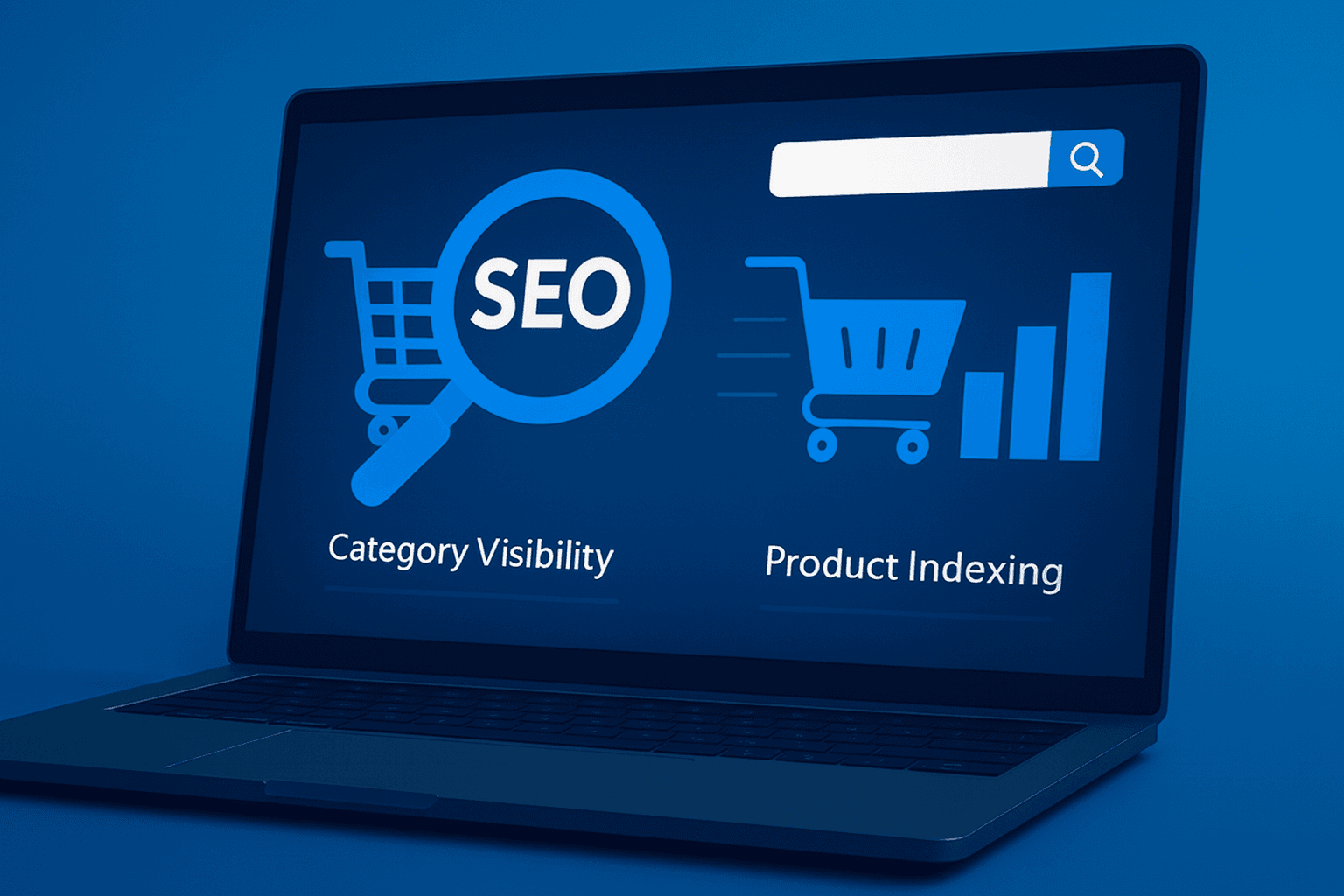
Effective SEO for online shops

An online shop only makes money when your products appear exactly where customers are looking for them. SEO for e-commerce is a process that combines technical optimisation, unique product content, site speed and an improved user experience — all designed to maximise traffic and actual transactions.

Check the SEO price list for SHOPs
Grafika ukazyjąca ikonki - Pozycjonowanie SEO sklepów

Search engine optimisation for online shops is the cornerstone of stable online sales 

At GBoost, we help boost your shop’s visibility for the most important product and shopping queries — so that users find you exactly when they’re looking for what you sell. E-commerce SEO combines category analysis, the technical foundations of your shop, product optimisation and UX, enabling you to scale your organic sales in a predictable and measurable way.

You reach customers who are ready to buy

E-commerce SEO enables you to appear in search results for queries that are closest to a purchase decision — from specific product models to detailed long-tail queries. This allows you to attract users who already know what they want and are looking for the best deal among competing online shops.

You attract traffic that actually converts, because it has a clear intention to buy.

Greater product visibility thanks to technical specifications

Google prioritises products that have complete data: title, description, specifications, availability, price, images and variants. E-commerce SEO organises these elements, removes duplicates and improves indexing, ensuring your products appear more frequently — both in standard SEO results and in product listings.

Products gain an edge in search engines without increasing the budget.

Stable sales growth driven by organic traffic

Advertising drives up costs, and competitors often outbid you. SEO for online shops builds a sustainable stream of sales that isn’t dependent on Ads bid prices. Products that are optimised and well-described generate traffic for months on end — and every new category or collection adds another ‘layer’ of visibility. 

You sell more without increasing your campaign spend.

BOOST YOUR SHOP'S VISIBILITY

What exactly do we optimise when carrying out SEO optimisation for your online shop?

In e-commerce, it’s not enough simply to ‘optimise the homepage for SEO’. We work on the category structure, product data, technical foundations and the shop’s performance, so that Google can better understand your offering and customers can find the products they want to buy more quickly.

User-specific category structure

Good SEO for an online shop starts with a clear structure. We organise categories so that they make sense to the user and are easy for Google to understand. This helps the shop build visibility more quickly for search terms related to products and their uses.

Full product details and attributes

Google rewards shops that have provided complete information on product titles, variants, technical specifications and availability. We ensure that these details are correct so that every product listing is complete and unambiguous. This makes indexing easier and eliminates errors that hinder visibility.

Unique category and product descriptions

In e-commerce, the most common problem is descriptions copied directly from manufacturers. We create simple, concise descriptions based on what users are looking for. This improves product visibility and makes it easier for Google to assess their quality.

Product metadata

We are introducing markup that provides Google with information about price, availability, reviews and variants. This enables products to appear in rich results and achieve a higher CTR.

Mobile site loading speed

We optimise images, scripts and page elements to reduce loading times. A faster online shop means fewer abandoned baskets and better Google rankings — especially on mobile, where traffic is highest.

Indexing and duplication checks

Online shops generate a huge number of subpages: filters, variants, pagination. We organise them so that Google only indexes those that are relevant to sales. This improves the quality of traffic and boosts the visibility of key categories and products.

GET STARTED WITH YOUR 
ONLINE STORE'S SEO

How we improve the visibility of products in your shop

We focus on two key areas: product visibility in search results and the quality of product data. Together, these drive steady growth in sales from organic traffic.

Product visibility on Google

We ensure that our products appear where users are actually looking for solutions – from general queries to highly specific search terms.

  • ●
    Optimising product pages for long-tail keywords that generate the highest conversion rates (e.g. specific models, sizes, uses).
  • ●
    Boosting the visibility of key categories, collections and bestsellers to capture traffic from queries with high purchase intent.

Product data quality

We organise product information so that it is clear to users and unambiguous for Google’s algorithms.

  • ●
    Simplified, search-optimised titles, clear descriptions and logical grouping of products within categories.
  • ●
    Consistent specifications, variants and attributes (e.g. sizes, colours, technical details) that help Google correctly identify and classify each product.
GET STARTED WITH YOUR 
ONLINE STORE'S SEO

How we use Google Merchant Center for online shop SEO

Google Merchant Center is where Google ‘reads’ your shop’s product listings from your product feed. If your feed is incomplete or contains errors, you’ll miss out on impressions, clicks and sales. When it’s properly optimised, your products are more likely to appear in Google Shopping, ad campaigns and organic search results.

When Merchant Center is neglected:

Products are being rejected, page views are falling, and Google is losing confidence in the data from your shop. This results in a direct loss of potential transactions for every search in which you could have appeared.

Once the feed and GMC have been finalised:

Products appear more frequently and in better positions, CTR and sales are on the rise, and paid campaigns and SEO efforts reinforce one another rather than pulling in different directions.

  • PROBLEM: DEFECTS AND PRODUCT REJECTS

Incorrect or incomplete data in the feed

Missing required fields, incorrect categories, unclear titles or price discrepancies result in products being rejected in Merchant Center and limit their visibility.

 ​HOW DO WE FIX IT?

We organise the feed structure, complete key attributes (including Google category, GTIN, brand and description), synchronise data with the shop and resolve the causes of rejections to maximise the number of active products.

  • PROBLEM: LOW CTR AND POOR VISIBILITY

Titles and descriptions that do not match the search queries

Product titles and descriptions that are too general or overloaded mean that Google rarely displays them, or only for low-value search queries, and users are less likely to click on them.

 ​HOW DO WE FIX IT?

We tailor the titles and descriptions in the feed to match users’ actual search queries, combining key shopping phrases with a clear message. The result: greater visibility, a higher click-through rate and more visits to the shop.

  • PROBLEM: LACK OF SYNERGY BETWEEN SEO AND CAMPAIGNS

Feed detached from the shop’s structure

When the category structure, product naming conventions and product feed are inconsistent, Google finds it difficult to assess the product range, and SEO and product campaigns yield mixed results.

 ​HOW DO WE FIX IT?

We standardise the shop’s structure, category names and title format, and then adapt the product feed accordingly. This enables Merchant Center to boost both organic results and paid campaigns.

GET STARTED WITH YOUR E-COMMERCE SEO

How does the SEO process for your online shop work?

E-commerce initiatives require a structured, phased approach. We work to ensure that each step builds on the previous one and delivers tangible growth in visibility, traffic and sales.

Technical audit and structural analysis

We assess speed, stability, indexing, and the structure of categories and subcategories to identify priorities for SEO and user experience optimisation.

Data organisation 

We refine titles, specifications, variants and descriptions so that Google can better understand each product and display it to users more frequently.

Feed optimisation and Merchant Center

We fix errors, rejections and missing data, synchronise the feed with the shop, and prepare the GMC to boost SEO and product campaigns.

Continuous development and monitoring 

We monitor visibility, traffic and conversions, making adjustments to products, categories and data to maintain and increase organic sales.

GET STARTED WITH SEO

Do you want to optimise your online shop for international markets?

We optimise websites and online shops not only in Poland, but in any country worldwide. Although optimising shops for the Polish market differs significantly from optimising for other markets (apart from the technical aspects), we are able to undertake the optimisation of your shop for a different market. Whether you want to optimise your online shop to explore a new market, boost sales in your current market, or for any other reason, SEO is always a sound and profitable investment.

Find out more about international SEO

Pricing for e-commerce SEO

Packages matched to your store size and target market. In every option we take care of technical SEO, products, categories and Google Merchant Center.

Small stores

E-commerce Start

A safe SEO start for smaller online stores. We organize the structure, basic product data and categories to start building stable traffic from Google.

Stores up to approx. 200 productsFirst SEO resultsLocal or national reach
€220
/ month excl. VAT
Keywords: up to 120
local and product-related shopping queries
Content: 3 pieces / month
category descriptions or short blog guides
Product optimization: up to 15 / month
titles, descriptions, attributes and Product / Offer structured data
Categories: 1–2 key pages / month
names, descriptions and internal linking cleanup
Feed and GMC: basic setup
store connection, basic fixes for errors and product disapprovals
Monthly reports
visibility, SEO traffic and key recommendations
Most popular

E-commerce Growth

An expanded package for stores that want to increase sales from SEO regularly. More keywords, content and product optimization, plus ongoing feed and Merchant Center work.

Growing and scaling stores200–1500 productsSteady traffic and order growth
€330
/ month excl. VAT
Keywords: up to 300
key categories, long-tail and transactional queries
Content: 6 pieces / month
categories, guides and content for the buying journey
Product optimization: 30+ / month
titles, descriptions, structured data, variants and attributes
Categories: 3–5 priority pages / month
structure rebuild, internal linking and metadata
Feed + GMC: ongoing optimization
disapproval fixes, attribute improvements and Google Shopping CTR support
Link-building: 4–6 / month
industry portals, topical profiles and guest articles
Competitor monitoring
visibility comparison and content gap identification
For leaders

E-commerce Authority

The strongest package for large stores and demanding industries. Intensive work on content, products, feed, links and conversion-oriented SEO.

Large stores and online brands500+ productsCompetitive industries
€480
/ month excl. VAT
Keywords: 500+
brand, categories, long-tail and informational-commercial queries
Content: 10–15 pieces / month
key category growth, blog, buying guides and FAQ
Product optimization: 50+ / month
full product data, variants, schema and product groups
Categories: 5–8 strategic pages / month
information architecture, filters, buying path and internal linking
Feed + GMC: full service
regular feed optimization, title tests and disapproval minimization
Link-building: 8–12 / month
sponsored articles, industry portals and topical authority
Conversion and UX monitoring
user behavior analysis and CRO recommendations for checkout

E-commerce SEO is not a cost,
it is a sales channel that works 24/7.

In e-commerce, SEO does not end with a few brand keywords. It combines a technically healthy online store, properly optimized categories and products, a clean product feed and visibility across Google and Google Merchant Center.

We work on specifics: we organize category structure, improve indexing, expand content around real shopping queries and make sure SEO traffic supports actual sales — not just clicks.

We can support both domestic and international growth, connecting store SEO with Google Ads, product campaigns and Merchant Center.

Do you still need a properly built online store? Start with solid foundations: order an online store in GBoost →

Have questions?
@ hello@gboost.eu ✆ +48 797 393 353
Please write to us via WhatsApp to arrange details or a meeting.
Please contact via WhatsApp only (no calls).
Step 1
Step 2
Step 3
Step 4
Selected package
E-commerce Start
Entry-level SEO package for smaller online stores. We organize technical SEO, categories and key products to start increasing sales from Google safely.
€220€330€1420
We help match the budget to your store size and growth plans — this form is only a starting point.

Frequently Asked Questions

What does the entire process of optimising an online shop look like from the moment we start working together?

The SEO process in e-commerce begins with a technical audit, a competitive analysis, and a check to ensure the shop is correctly structured in terms of UX and Core Web Vitals. We then set priorities: which categories have the greatest sales potential, where there are gaps in content, and which keywords are likely to drive the fastest growth in traffic. After the strategy phase, we move on to technical implementations, content optimisation, category structure, product descriptions and building authority (link building). The whole process is ongoing — SEO is an investment where the results accumulate month by month.

How long does it take to see tangible results from SEO for an online shop?

The first noticeable increases in visibility usually appear after 6–12 weeks, whilst the full potential of an e-commerce site’s SEO takes several months to develop. This is due to competition, Google’s indexing process, and the fact that an online shop often has a very large number of subpages. SEO does not work like an advertising campaign – you cannot simply ‘switch it on and expect it to work immediately’ – but once rankings have stabilised, it delivers the cheapest and most predictable traffic in the long term.

What factors influence the cost of SEO for an online shop?

The cost of SEO depends, among other things, on:
– the size of the shop (number of categories and products),
– its technical condition and any errors to be fixed,
– the competitiveness of the industry,– the amount of content to be created,
– the intensity of link building.

We do not use ‘arbitrary rates’. The price is based on the actual amount of work required for the shop to generate stable revenue from Google’s organic search results.

Is SEO for e-commerce shops safe?

Yes — provided it is carried out in accordance with Google’s guidelines. We use white-hat techniques, focusing on content quality, proper category structure, user experience and safe linking. We do not use spam networks, link exchange schemes or methods that risk getting the site blocked. SEO for online shops, when done professionally, builds domain authority and business value that lasts for years.

How does SEO for an online shop differ from SEO for a standard website?

An online shop has:
– a multi-tiered category structure,
– often thousands of products,
– dynamic filters and technical parameters,
– issues with duplicate content (e.g. identical descriptions from manufacturers),
– far greater challenges relating to indexing.

That is why e-commerce SEO requires a completely different approach — from implementing correct URLs to optimising filters, pagination, data structure, schemas (rich snippets) and daily monitoring.

Do I need blog content if I already have a product and a category?

Yes, a blog is one of the most important elements in building organic traffic. Categories and products mainly rank for transactional keywords, whilst the blog allows you to capture informational traffic — guides, comparisons, rankings, and answers to users’ questions. This supports the shop’s SEO, builds authority (E-E-A-T) and attracts users at various stages of the purchase journey, ultimately increasing conversions.

Can I stop the SEO work after a few months, once we’ve achieved good results?

It is possible, but it is not recommended. Competition in e-commerce never sleeps, and Google is constantly updating its algorithms. Even if a shop achieves high rankings, a lack of further action (optimisation, new content, analysis of changes, updating descriptions) can lead to a gradual decline. SEO is an ongoing process — just like the technical maintenance of the shop or the development of the product range.

Is link building really necessary?

In e-commerce SEO, link building is one of the key factors. Google assesses not only the quality of a website but also its online authority. High-quality, relevant, and natural links (e.g. industry portals, expert articles, sponsored content) strengthen the domain and boost the search rankings of categories and products. However, it is important that linking is of high quality and well-thought-out – not mass-produced.

What if my shop has hundreds or thousands of products with identical descriptions?

This is one of the most common problems in e-commerce SEO. Duplicate content means that Google doesn’t know which subpage to treat as the main one. As a result, the visibility of the entire shop drops. In such situations, we create unique descriptions for key products, implement structured data, correct meta tags and apply canonical rules. We set priorities to maximise results within a limited timeframe — there’s no need to rewrite everything at once.

How do we measure the effectiveness of an online shop’s SEO?

We rely on hard data:
– increased visibility on Google,
– organic traffic,– number of transactions from SEO,
– revenue from organic traffic,
– improvement in Core Web Vitals,
– indexing and technical health.

This gives you a full insight into how SEO impacts sales, not just keyword rankings. We provide clear reporting and every change is documented.

Find out more about SEO

Contents: 
1. How do you optimise your shop for SEO?
2. What affects the visibility of categories?
3. The most common SEO mistakes made by online shops
4. How do you build domain authority?
5. SEO vs UX — which has a greater impact?
6. How do you create content that sells?
7. Safe link building for e-commerce
8. How much does SEO for an online shop actually cost?

How do you optimise your online shop for SEO?

Preparing a shop for SEO begins with a thorough analysis of its technical foundations — these determine whether a search engine will be able to correctly read and understand your shop at all. At this stage, we primarily check loading speed, URL structure, indexing accuracy, and the way Google’s crawlers navigate between categories, products and filters. If there are technical errors, an unclear hierarchy or chaos in the URLs, even the best content will not deliver the expected results.

A very important part of preparing a shop is also an audit of the navigation and the logic of the entire category structure. The shop must operate intuitively for the user, but also predictably for search engine algorithms. We check whether categories are arranged hierarchically, whether products have duplicate URLs, and whether filters generate an infinite number of incorrect subpages. This is crucial so that Google can quickly and correctly index the most important elements of the shop, and so that the user can navigate it comfortably and without hindrance.

The second pillar of preparing a shop for SEO is content. In e-commerce, it is the category and product descriptions, along with additional materials — guides, rankings, and blogs — that determine whether the shop meets customers’ real needs. They must be unique, linguistically natural, and designed to support sales, not just to cram in keywords. In practice, this means expanding descriptions, adding educational sections, and creating content based on search engine data and audience behaviour. Google rates shops much more highly when they invest in substantive content rather than simply duplicating manufacturers’ descriptions.

Finally, we prepare the shop technically for long-term SEO scaling — we implement structured data, canonicalise duplicates, improve the sitemap, set up pagination, eliminate 404 errors and prepare the shop for stable indexing. This stage is very often overlooked, yet it is precisely this that determines whether the shop will grow quickly and steadily, or remain stagnant despite the publication of new products. Well-built foundations ensure that every subsequent SEO step works more predictably and delivers visible results in a shorter time.


What affects the visibility of categories?

The visibility of categories in an online shop depends primarily on how well both users and Google’s algorithms understand them. Categories are often the strongest subpages in the entire shop — they attract traffic for search terms that actually lead to a purchase. Therefore, their optimisation must take into account a logical structure, strong content, correct meta tags and intuitive navigation. Google analyses not only keywords but also how users behave on the page: whether they scroll, click, proceed to products, and whether they quickly find what they are looking for.

The way a shop presents its range also has a huge impact on category visibility. It is not only unique category descriptions that are important, but also product consistency, correct technical specifications, the structure of filters, and whether the user can quickly narrow down their selection. If filtering generates unreadable URLs or hundreds of duplicates, Google may struggle to understand the page correctly, which directly weakens its rankings. A properly implemented information architecture, on the other hand, enables crawlers to index the shop faster and more accurately, and directs traffic to the most important subpages.

It is also worth ensuring elements that build trust — reviews, product images, FAQs, comparisons, and how-to content related to the category. This encourages users to stay on the site longer, and Google interprets such signals as a sign of quality and relevance. Categories that are rich in content, correctly labelled, fast and user-friendly are far more likely to achieve stable rankings in search results and generate valuable sales traffic.

The most common SEO mistakes for online shops

In e-commerce, most SEO issues stem from technical errors which may not be immediately apparent but effectively hinder the shop’s visibility. One of the most serious of these is duplicate content — identical product descriptions, duplicated meta tags or copying content from manufacturers mean that Google does not know which version of the page to treat as the main one. The result? Low rankings, poor indexing and unnecessary dilution of the entire domain’s authority. Malfunctioning filters can also be problematic, generating hundreds or thousands of unnecessary URLs. Google’s crawlers attempt to index them, wasting the indexing budget, whilst key subpages — categories and products — appear in search results with a delay or not at all.

Another common mistake is poorly designed category pagination, a lack of logical heading structure, and incorrectly set canonical tags. It is the canonical tags that determine which version of a subpage should be treated as the original. If they are set incorrectly or are missing altogether, Google may index random versions of pages, and important content remains ‘hidden’ in search results. The same applies to 404 errors — individually, they are not a problem, but hundreds of non-existent subpages can disrupt the consistency of the shop and make it difficult for algorithms to assess the quality of the entire domain.

Many shops also lose visibility because they do not use structured data. This data allows the search engine to understand what a given subpage is — a product, a category, an article or a review. Appropriate markup also helps display rich search results (rich snippets), such as price, availability or product ratings. Correct implementation can be based on the official documentation from Schema.org , which describes all markup types in detail. Without this, a shop fails to utilise the full potential of its presentation on Google and often loses out to competitors who do it better.

Only after these key elements — duplication, indexing, filters, structured data and information architecture — have been sorted out can visibility be built in a stable and predictable manner. A shop free of basic errors grows faster, more effectively and is far more resilient to algorithm changes.

How do you build domain authority?

Domain authority in e-commerce is one of the most important factors influencing a shop’s visibility on Google. It is not a single number or metric from an SEO tool, but a set of signals that the search engine interprets as evidence of your shop’s quality, reliability and credibility. Authority is built on three key pillars: content, links and user experience. If a shop provides valuable information, has high-quality links from credible sources and delivers excellent customer service, the algorithms treat it as a brand worth recommending — and this translates into higher rankings for the most competitive search terms.

Expert content plays the most important role. Shops that publish buying guides, product comparisons, rankings and educational articles find it easier to gain the trust of both users and Google. Such content demonstrates that the brand knows its industry and addresses the real needs of its audience. Additionally, it increases time on site, page views and interactions, which Google interprets as positive behavioural signals. This is one of the most effective ways to build authority without aggressive link building.

The second pillar is inbound links. However, it is not about quantity, but quality. A link from a small blog with high topical credibility may be more valuable than a link from a large portal that does not fit the context of your industry. The key is to acquire natural links — those that appear thanks to good content, industry publications, reviews or thematic collaborations. We avoid link exchange schemes and mass link farms, as they can do more harm than good.

The third area is customer experience, which comprises website speed, clarity, image quality, reviews, the purchasing process and after-sales service. Google heavily rewards shops that build trust and care about their brand reputation. Positive reviews, comprehensive product descriptions, efficient technical support and a clear ordering process are all signs that the shop is reliable and secure — and this directly strengthens the domain’s authority.

Building authority is an ongoing process, but the effect is long-lasting. Once a domain has a strong reputation, it begins to rank faster, more consistently, and for increasingly competitive keywords, outperforming the competition not only through SEO quality but also through brand quality.

SEO vs UX — which has the greater impact?

SEO and UX are two areas that are often treated separately, although in reality they are inextricably linked. In an online shop, you won’t achieve high rankings without good usability, and a great UX won’t generate sales if the shop isn’t visible on Google. SEO ensures that the user finds the shop, whilst UX makes them stay, browse the range and complete a purchase. In practice, this means that both elements reinforce each other’s effects — the better the user experience, the stronger the behavioural signals, and the better the shop is technically optimised, the easier it is for Google to promote it in search results.

UX influences SEO through time spent on the site, bounce rate, ease of navigation and speed of finding a product. If a user cannot find categories, filters or product details, they quickly leave the site, which the search engine interprets as a signal of low quality. Google makes it very clear that user experience is a priority — shops that are fast, intuitive and clear achieve higher rankings because they better fulfil users’ goals. This is precisely why optimising Core Web Vitals, responsiveness and simplicity of navigation are of such great strategic value.

On the other hand, UX without SEO is like a brilliantly designed brick-and-mortar shop… tucked away in a side street with no signage. If Google cannot index the categories properly, the product has duplicate content, or the URL structure is chaotic, users simply won’t find the site. SEO ensures visibility, but it is UX that turns traffic into conversions. That is why both areas must work in parallel — technical correctness, valuable content and intuitive information architecture form the foundation, whilst UX is the way in which the user experiences these elements.

The best results are achieved by shops that combine SEO and UX thinking right from the design or redevelopment stage. This approach minimises costs and maximises results, as every element — from content to page layout — meets both Google’s requirements and the user’s needs. In practice, it is precisely these shops that have the highest conversion rates and grow most steadily.

How do you create content that sells?

Content in an online shop is much more than just product descriptions. It is a complete information architecture that guides the user from their first visit right through to completing a purchase. ‘Sales-driving’ content is content that answers customers’ real questions, dispels doubts, explains the differences between products and helps them make a purchasing decision. Google is getting better and better at analysing the substantive value of content, which is why shops that invest in descriptive, expert and easy-to-read materials gain a competitive edge in both search results and conversions.

The most important thing is that every category and every key product has unique, well-thought-out descriptions. It’s not about ‘stuffing in keywords’, but about presenting information in an accessible way that customers really want to know: how models differ, how to choose the right variant, what the technical specifications are, and what problems a given product solves. A well-written description not only boosts SEO, but above all increases trust in the shop and shortens the purchase journey. In practice, this means adding educational sections, comparisons, FAQs for categories, and short tips to help with product selection.

Supporting content also plays a huge role — guides, rankings, comparisons, case studies and blog articles. These build expertise (E-E-A-T), attract traffic at earlier stages of the purchasing process and help users return to the shop when they are ready to buy. The more expert and original the content, the higher the user engagement, the lower the bounce rate, and the stronger the domain authority in Google’s eyes.

The key to creating content that sells lies in combining SEO with an analysis of purchase intent. Each section of the description should answer a specific user question — from simple ones (“What is it?”), through comparative ones (“Which model should I choose?”), to decision-making ones (“Does this product solve my problem?”). Content structured in this way acts like the best salesperson: it doesn’t push, but guides the user step by step towards a purchase.

How much does SEO for an online shop cost?

The cost of SEO for an online shop depends primarily on the scope of work, the competitiveness of the industry, the size of the product range, and the technical condition of the website. E-commerce is one of the most demanding areas of SEO, as an online shop generates hundreds or thousands of subpages that must be properly optimised, indexed and maintained. Therefore, the price of SEO is not based on a ‘monthly fee for a few keywords’, but on the actual amount of work carried out by specialists, analysts, copywriters, developers and strategists who manage the shop month after month. The more complex the project, the more extensive the work required, and consequently the higher the investment.

The cost is primarily influenced by three elements: audits and technical fixes, content creation and domain authority building. If a shop has numerous technical errors, incorrect indexing, duplicate content or unreadable URLs, fixing these issues is crucial and time-consuming. Next comes the creation of category descriptions, product pages, guides and educational sections, which boost visibility and sales. The final pillar is link building, which requires systematic efforts and high-quality publications, particularly in competitive industries.

It is worth remembering that SEO is not a one-off expense, but a long-term investment that outperforms other sources of traffic acquisition in terms of cost-effectiveness. Unlike advertising campaigns, which stop working once the budget is exhausted, organic traffic continues to generate results for months, or even years. That is why shops that invest in SEO regularly achieve stable results, lower customer acquisition costs and a significantly greater competitive advantage. From a business perspective, it is one of the most profitable marketing strategies — particularly in sectors where customers compare offers and return to search engines repeatedly.

The best results are achieved by shops that treat SEO as a permanent part of the company’s development, rather than a side expense. This approach not only accelerates the growth in visibility, but above all stabilises sales and ensures that the shop is not solely dependent on paid advertising.

GET STARTED WITH INTERNATIONAL SEO