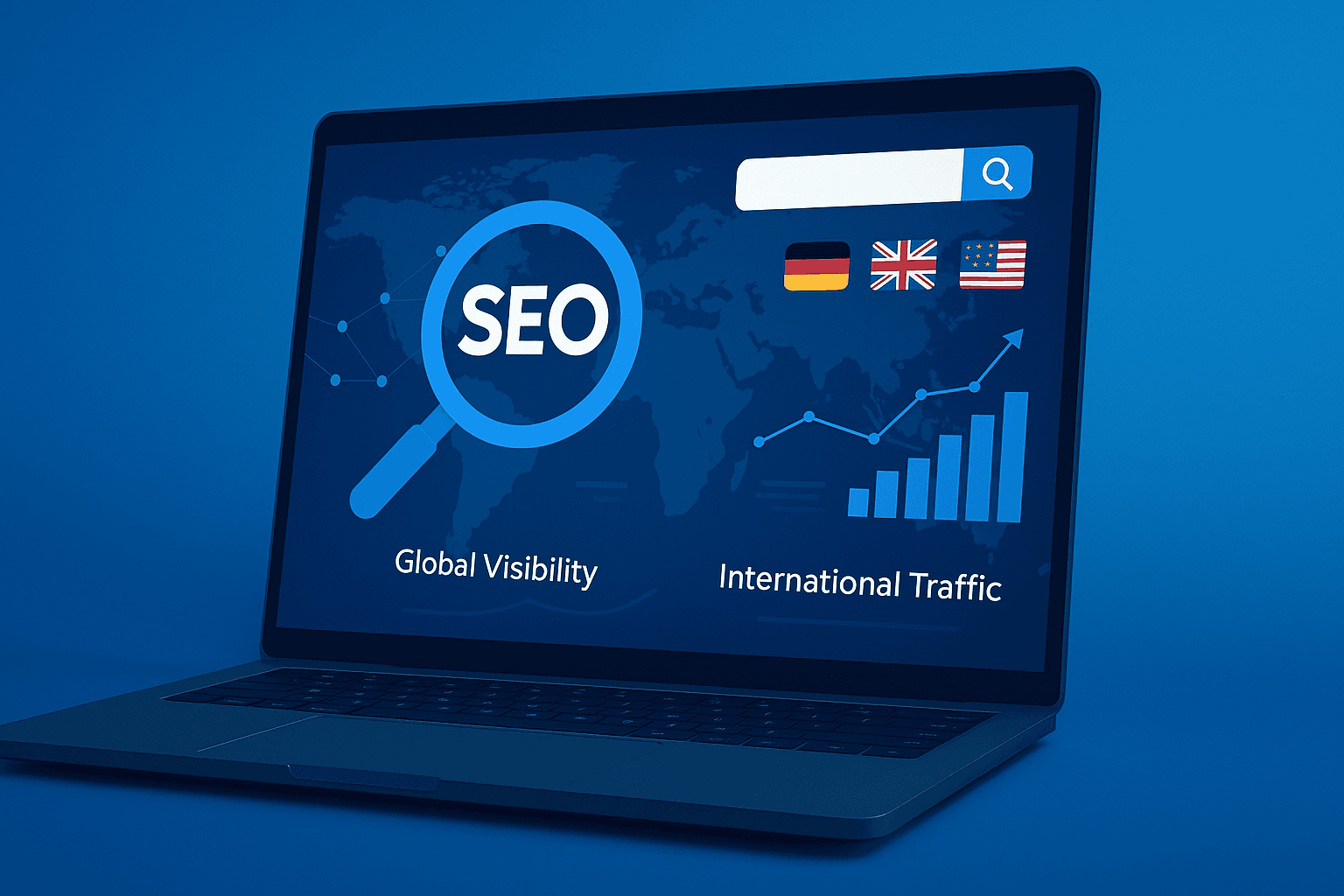
Attract customers through international SEO

Your website can also sell outside Poland — provided it appears in Google search results in markets where people are actually looking for your services. International SEO is a process that takes into account language differences, market competitiveness and local user intent. 

Check our SEO price list
Grafika ukazyjąca ikonki - Pozycjonowanie SEO zagraniczne

If you're thinking about customers abroad, you've come to the right place.

This page is dedicated to SEO in international markets – building visibility on Google in countries such as Germany, the UK, the US and across the EU. Here, we focus on international expansion strategies, differences between markets and a practical approach to SEO abroad.

If you’re just starting out and want to get to grips with the basics first, we’ve put together a separate page that explains, step by step, what SEO is and how it works in Poland.

LEARN ABOUT SEO

How does international SEO differ from standard SEO?

The basic principles of SEO are similar, but when working abroad, there are a few key challenges that many companies overlook:

  • competition with international brands in much more demanding markets,
  • building links from local websites, industry portals and media outlets,
  •  correct implementation of hreflang, domain structure and page load speeds across different countries,
  • analysing data from multiple markets and continuously adapting strategies.

Further down this page, we’ll show you our step-by-step approach to international SEO and how it translates into real customers from abroad.

SEO is the key to success abroad

At GBoost, we help you expand your business into international markets – so that customers in Germany, the UK, the US and other countries can easily find your company on Google. Our international SEO strategy combines market analysis, language, technology and content, enabling you to scale your business beyond Poland in a predictable and measurable way.

Reaching customers in other countries

International SEO allows you to reach people who are searching for your services in their own language – on Google DE, Google UK or Google US. This significantly boosts the effectiveness and quality of your traffic, as you reach users who already have a purchase intent but are not yet familiar with your brand. 

You reach customers who would never have seen your adverts in this country.

An advantage over local competitors in another country

In foreign markets, you often find yourself competing against companies that lack the technical know-how, have weaker content, or do not approach SEO strategically. Effective international optimisation allows you to outpace them more quickly than you would in the crowded Polish market. 

It’s easier to rank highly where the quality of SEO competition is lower.

Scaling up sales without opening new branches

Expanding into new markets no longer requires a physical presence — international SEO allows you to test and grow your sales in several countries at once, with virtually no increase in operating costs. 

You can expand your business globally without investing in infrastructure.

launch SEO abroad

Learn about the specific SEO characteristics of individual markets

Below is a list of the markets with the greatest SEO potential, along with their key characteristics. This list will help you understand the specific nature of each market, and will enable us to define your objectives, your needs and the needs of the market in question with even greater precision – which directly translates into exceptionally high effectiveness when it comes to SEO optimisation abroad.

Countries — Europe
Select a country to view SEO details

Do you not see your country? Write to us — we provide SEO services for any market worldwide.

Why is SEO abroad a completely different process to that in Poland?

International SEO involves working with new data, new user behaviours, different competitors and different search algorithms. It is a separate strategy, tailored specifically to the country or region where you wish to attract customers.

Other user behaviours

W każdym kraju ludzie inaczej formułują zapytania i inaczej szukają usług. Analiza słów kluczowych zaczyna się tu od zera, a nie od tłumaczenia fraz z polskiego.

A different competitive landscape

In some countries, the market is more mature, whilst in others it is less so. An SEO strategy must be tailored to the realities of a specific market, rather than simply copying the model used in Poland.

Language versions and indexing

The website must correctly support different languages, URL structures and hreflang tags. This is crucial for visibility in each country individually.

Links from local markets

Google ranks a website based on links from the country where you want to be visible. You need to build local authority from scratch – it doesn’t carry over from Poland.

Greater technical sensitivity

Multilingual websites require fast global loading times (CDN), a sound structure and a high-quality user experience. Search engines abroad place greater emphasis on these factors.

Various costs of acquiring traffic

In many countries, paid advertising is expensive, which is why SEO is becoming a key channel for customer acquisition. The strategy must take into account the economics of the market in question.

GET STARTED WITH SEO

The sectors seeing the strongest growth thanks to SEO abroad

International SEO works best in markets where customers actively search for offers online and compare suppliers. Below are a few industry sectors that most frequently see the greatest increase in traffic and enquiries from international markets.

E-Commerce

Products that can be shipped anywhere

Online shops, fashion brands, cosmetics, electronics, supplements. Customers abroad actively compare prices and reviews – a well-optimised shop quickly converts traffic into sales.

Specialist services 

Experts wanted worldwide

Law firms, architects, consultancy, IT, private healthcare, online education. Given the high value of each individual client, every lead generated through SEO has a tangible impact on revenue.

Manufacturing and B2B

New overseas business partners

Manufacturers, wholesalers, the industrial sector, construction, and the automotive industry. Well-executed international SEO attracts enquiries from distributors and business partners, not just retail customers.

Tourism and local services

Visitors and tourists from all over the world

Hotels, apartments, restaurants, beauty & wellness, transport. Tourists and expats search for services using local and English-language phrases – visibility in search results translates into bookings.

International SEO pricing

Entry into 1 market

International Start

A safe start for SEO in one country. We adapt keywords and content to the local language, organize the website and build the first stable visibility in search.

Small companies / e-commerceEntry into 1 foreign marketFirst leads and sales
€260
/ month excl. VAT / country
Keywords: 20–40
local queries in the target country language
Content: 2–3 pieces / month
offer pages, landing pages and service sections
Link-building: 2–3 / month
local directories, industry profiles and map listings
Content and metadata localization
language, wording and arguments adjusted to the market
Monthly reports
visibility, rankings and traffic from the selected country
Most popular

International Growth

An expanded strategy for companies that want real growth in a selected market. More keywords, more content and stronger link building mean greater market share and a steady flow of enquiries.

Scaling sales abroadE-commerce / B2B servicesStrong position in 1 country
€430
/ month excl. VAT / country
Keywords: 60–100
key categories, long-tail and transactional queries
Content: 4–6 pieces / month
blog, guides and expanded offer pages
SEO landing pages: 4–6 / month
services, locations and customer segments in the target country
Link-building: 4–6 / month
topic portals, local services and expert profiles
Competitor monitoring
visibility comparison and content gap identification
For leaders

International Authority

Maximum visibility and strong brand building in strategic markets. Broad topic coverage, intensive content and stronger link building support TOP3 rankings and long-term sales growth.

Strong brands and online storesCompetitive industriesTOP3 ambition in a country
€660
/ month excl. VAT / country
Keywords: 150–300+
brand, generic keywords, long-tail and informational queries
Content: 8–15 pieces / month
topic hubs, guides and expansion of key sections
SEO landing pages: 8–12 / month
customer segments, local markets and product categories
Premium link-building
sponsored articles, industry portals and expert publications
Expansion strategy
plan for entering new markets and coordinating SEO activities
Calculate international SEO for multiple countries
The discount increases with the number of markets: 10%, 15% or 20%.
Number of markets / countries
1 country
Price before discount:€260 / month
Market discount:0%
Price after discount:€260 / month
The discount is calculated from the value of all selected markets in the selected package.

SEO is not a sprint,
it is a long-term, profitable investment.

Effective international SEO is not a short campaign. It is a process that increases your visibility, authority and number of enquiries month after month.

Every campaign starts with solid foundations: a technically sound website, valuable content, safe link building and a clear market-entry strategy.

SEO will not work properly without a well-built website. If you do not have one yet, start with the basics: order a website from GBoost →

Have questions?
@ hello@gboost.eu +48 797 393 353
Please write to us via WhatsApp to arrange details or a meeting.
Please contact via WhatsApp only (no calls).
Step 1
Step 2
Step 3
Selected package
Start International SEO
Entry into 1–2 foreign markets. Key page localization, local keywords and first links.
€170€170€950
A higher budget allows broader and faster work, especially across several markets at the same time.

Frequently Asked Questions

Is international SEO different from SEO in Poland?

Yes, it differs significantly. When it comes to SEO abroad, we look not only at keywords, but at the full context of a given country: search behaviour, the level of competition, user behaviour and local quality expectations. That is why a strategy for Germany, Austria or France will never be identical to that for Poland.

Is SEO more difficult abroad?

It doesn’t always require a more detailed plan, but it usually does. Overseas markets tend to be more mature, and users expect specific information and high-quality content. The key is adaptation — not difficulty. A well-prepared strategy ensures that market entry proceeds smoothly and predictably.

Do I need to have a website in the language of the country where I want to rank?

Yes — if you want to see real results. Google ranks websites based on the user’s language, which is why international SEO requires tailored language versions. It’s not just about simple translations, but about content tailored to the specific behaviour of audiences in a given country.

Why do you highlight the differences between countries on the website?

This is because international SEO works differently depending on the market. Germany is highly competitive and its users are quality-conscious. Austria is more of a premium market, but search volumes are lower. Scandinavia is a predictable market, but very demanding in terms of content. We highlight these differences so that clients know what to expect and how to choose the right strategy.

Why do I need an SEO potential analysis for specific countries?

So you’re not just flying blind. SEO abroad is an investment — which is why you need to check whether the market has real potential. We analyse keyword popularity, the level of competition, user behaviour and the profitability of the industry. This means the client knows straight away whether entering a particular market makes business sense.

Can I optimise my website for search engines in several countries at the same time?

Yes, but only with the right website structure and content strategy. International SEO can work across multiple markets simultaneously, provided that each market has its own content, keyword analysis and tailored user journey. Without this, the results become muddled and Google won’t know which market is your priority.

Is international SEO worthwhile for small businesses?

Definitely yes, provided they operate in an industry with potential. Many niches abroad offer higher customer value, fewer local competitors and greater demand than in Poland. That is why even a small business can achieve excellent results if it chooses a market that suits its capabilities.

How long does it take to enter a foreign market using SEO?

Usually 3–6 months, depending on the country and the level of competition. Some markets ‘bounce back’ more quickly (e.g. niche EU countries), whilst others take longer (Germany, the Netherlands). That is why our strategy sets out an indicative timeframe for each country before the first results become apparent.

Does SEO abroad require a different type of content?

Yes — and that’s the key to success. Every market reacts differently to text length, tone, the way an offer is presented, and sales pitches. That’s why we create content with the audience of a specific country in mind, rather than producing a ‘one-size-fits-all’ text that’s simply translated into five languages.

What sets GBoost apart in international SEO?

When it comes to international SEO, we don’t take a one-size-fits-all approach. For each country, we draw up a bespoke plan: market analysis, user profiles, competitor analysis, and a list of opportunities and risks. We create locally tailored content, and the entire strategy is transparent — the client can see exactly how their campaign is performing, what can be scaled up, and which countries offer the greatest potential.

Find out more about SEO

Spis treści: 
1. How does international SEO work, and why is it different from SEO in Poland?
2. How do you choose the best countries to start international SEO?
3. Differences in user behaviour across different countries — what do you need to know before you start?
4. Why does content need to be localised? How do you create effective content for international markets?
5. How much does SEO cost abroad, and what factors influence the final budget?
6. Link building abroad — how do you acquire high-quality links in international markets?
7. How can you measure the results of international SEO and assess whether the market is delivering a return?
8. The most common mistakes in international SEO and how to avoid them right from the start?

How does international SEO work, and why is it different from SEO in Poland?

International SEO is a structured process of increasing a website’s visibility across multiple markets simultaneously — not limited to Europe. It covers both countries with highly mature online ecosystems (Germany, the US, the UK) and emerging markets where competition is lower but growth rates are enormous (e.g. South America, South-East Asian countries). That is why SEO abroad does not follow a single universal formula. Each market has its own ‘search language’, different content standards, distinct linking rules and varying user behaviours — often radically different from what we are used to in Poland.

In international SEO, Google analyses not only the language of the website but the entire context: domain structure, local phrases, content quality, alignment with user intent, and brand credibility in a specific market. Different ranking signals dominate in the US, where the immense substantive value of content and domain authority are key. The situation is quite different, for example, in the Nordic countries, where Google prefers simplicity, clarity and precise information. In Japan, on the other hand, detail, page structure and full linguistic formality are often key. The situation is yet again different in Arab, African or Latin American markets, where user behaviour tends to be more dynamic and competition is often less organised.

This means that international SEO requires the creation of a separate strategy for each country — not just translating content and throwing in a few keywords. You need to understand how users search, what they expect, and how Google assesses a website’s local value. Only then does international SEO begin to work to its full potential and attract real customers, rather than just traffic.

How to choose the best countries to start international SEO?

In international SEO, choosing the right country is one of the most important elements of the entire strategy — often more crucial than the selection of keywords itself. Every market operates in a completely different technological, cultural and business environment. That is why you first analyse where your offering has the greatest chance of scaling, and only then plan your international SEO activities. The situation is different in Europe, different in America, and yet different again in regions such as the Middle East or South-East Asia.

The first step is to assess the potential of keywords. We don’t do this based on intuition, but on real data: we check search volume, industry competitiveness, seasonality, and whether users are actually looking for the solutions you offer. Sometimes it turns out that a small country, such as Denmark or Norway, can yield a higher return than a large market where competition is fierce. That is precisely why the analysis is based not on the ‘size of the country’, but on how well your product or service matches the real needs of your audience.

The second element is user behaviour and their purchasing preferences. In the US, product reviews, transparency and extensive content play a huge role. In Scandinavia, users value minimalism and simplicity of design. In South-East Asia, conversions are rising sharply thanks to mobile usage, as traffic from mobile phones can exceed 80–90% there. In South America, the dynamic growth of e-commerce makes markets less predictable, but they often offer spectacular growth rates on a reasonable budget.

The third step is to analyse the competition. When it comes to international SEO, we don’t just look at ‘who’s number one’, but at the whole market picture: what types of content dominate, which sites are at the top, what the local SEO landscape looks like (e.g. for service industries), and whether users respond more to expert content, how-to guides or promotional content. The differences are huge — in some countries, Google strongly promotes substantive content, whilst in others, domain authority and history matter more.

The fourth, very often overlooked factor is the market entry barrier. Even a small country can generate significant sales if local businesses do not invest in SEO or do so ineffectively. In many regions of the world (e.g. parts of South America, certain Arab countries or North Africa), there is a lack of competition that meets European standards for content quality — and this is a huge advantage for companies operating professionally.

Only after going through these stages is it possible to determine where it is worthwhile to carry out international SEO, and where such a move will not bring value. This ensures that the client does not waste their budget on markets that only appear attractive on the surface, but invests where data and analysis show real potential.

Differences in user behaviour across different countries — what do you need to know before you start?

One of the most important aspects of international SEO is understanding that users in different countries search differently, compare offers differently and make purchasing decisions differently. What works in Poland may not work at all in Germany, the USA, Japan, Australia or Arab countries. Every market has its own ‘character’, its own behavioural patterns and different expectations of websites. That is why SEO abroad does not start with keywords, but with an analysis of how users think and what they actually need.

In Western European countries, users pay more attention to brand credibility, reviews and full transparency of the offer. In the US, what counts is aggressive, direct communication and a strong sales pitch backed by real data. In Japan, users expect maximum precision, a clear structure and full linguistic formality. In India, Indonesia and the Philippines, a ‘mobile-first’ approach dominates — most purchasing decisions are made on a mobile phone, and the website must load instantly even on weaker devices.

These differences have a direct impact on international SEO strategy. If users in a given country expect long guides — we prepare comprehensive content. If they prefer minimalist pages, we shorten the text block and base it on clear bullet points and comparisons. If a purchasing decision is preceded by a thorough check of reviews, we strengthen the social proof sections. In many countries, user behaviour is also more emotional (e.g. South America), so it’s worth focusing on simple and motivating communication.

It is worth remembering that Google also evaluates websites through the lens of local user behaviour. If a particular audience group is more likely to leave the site after a few seconds, interacts less, or seeks more detailed answers to their questions — the algorithm will interpret this as a content mismatch. That is why SEO abroad is not about copying content that works in Poland, but building communication and structure tailored to the specific needs of the market, even if this means creating completely different versions of the same subpage. It is this stage that determines whether a website will ‘take off’ in a given country or not.

How much does international SEO cost and what factors influence the final budget?

The cost of international SEO depends primarily on which markets you wish to enter, how fierce the competition is, and how many language versions your website requires. International SEO is not a single campaign, but a set of activities tailored to each country individually — which is why the budget varies depending on the market. Entering a highly competitive market, such as the US or Germany, requires a greater investment than launching in countries with fewer local companies investing in SEO.

The cost is also influenced by the amount of content that needs to be produced. Whilst in Poland a single comprehensive article on a given topic may suffice, when optimising for search engines abroad, the same topic may require several versions: one for the UK, another for Canada, and yet another for Australia, even though all use the English language. Each market has its own linguistic nuances and distinct search intent.

Added to this is link building — often more expensive than in Poland, as it requires acquiring links from local, reputable domains and websites. In some countries (e.g. Scandinavia, the USA, Japan), publication costs are significantly higher due to quality standards. Conversely, in developing regions (parts of Asia, South America), link building may be cheaper, but requires greater care to avoid low-quality sources.

The final budget is only determined after analysing the market’s potential — this ensures the cost is proportionate to the realistic chances of acquiring customers. Well-planned international SEO is an investment that grows over time and delivers a stable return, which is why a strategic approach to each country is crucial.

Link building abroad — how do you acquire valuable links in international markets?

Link building in international SEO differs from what we are used to in the Polish market, as Google evaluates links primarily in terms of locality and credibility. For international SEO to have a real impact, links must come from domains that are considered authoritative in the relevant country. A link from a German .de domain boosts visibility in Germany, but will have a much smaller impact on the British, American or Spanish markets. Conversely, links from US websites may work very well in North America, but will not necessarily improve visibility in Scandinavian countries.

The second key element is the type of site from which we acquire a link. In international SEO, it is not only domain authority that counts, but also relevance. Industry portals, expert sites and local news sites are of greater value than directories or general-interest portals. In many countries (the US, UK, Canada, Scandinavia), editorial teams place great emphasis on the quality of publications, so acquiring links requires solid content, data or educational value. In developing regions, link building is simpler and cheaper, but requires caution — many websites do not meet Google’s technical standards and may do more harm than good.

Markets also have their own specific rules. For example, the United States is very ‘data-driven’ — links are best acquired there through content that presents statistics, case studies and reports. In Arab countries, partnerships with local websites and institutions are often key, as this builds audience trust. In South-East Asia, on the other hand, expert publications and how-to articles work very well. That is why, in international SEO, a link-building plan always varies depending on the chosen market and online culture.

In practice, the most effective strategy combines several methods:

• guest posts in local media,

• expert and how-to articles tailored to the country,

• links acquired through extensive content (e.g. reports, guides),

• partnerships with local companies and websites,

• presence in reputable directories of companies/organisations in the region.

This mix creates a natural link profile and boosts the website’s visibility in specific markets. Google interprets this as a genuine brand presence in a given country, which translates not only into better rankings but also into increased user trust.

How can you measure the results of international SEO and assess whether a market is delivering a return?

The effectiveness of international SEO is measured differently from traditional SEO in Poland, as each country develops at a different pace and requires separate analysis. The most important thing is that we do not look solely at keyword rankings — in international SEO, market fit signals are key. This means we analyse not only traffic but also the quality of visits from a given country: time on site, number of interactions, user paths, bounce rate, clicks on offers or forms, and conversions. Only this set of data shows whether the market is actually responding to your product or service.

To assess visibility, we use separate views in Google Analytics and Google Search Console for each country. This allows us to clearly see how the German version is performing, how the US version is performing, and how the versions targeting the UK or Australia are performing. In international SEO, it is also important how quickly Google indexes new content in a given market — some countries ‘catch on’ faster, whilst others take several weeks before the first data appears. This is normal and stems from differences in competition and user characteristics.

The next step is to analyse conversions. In international SEO, visibility alone is not enough — what matters is whether users actually engage with the offering. In some countries, you may need to prepare, for example, more detailed service descriptions, add FAQs addressing local queries, or expand the social proof sections to boost trust levels. Each market requires different sales angles and different arguments, so testing content for results is a constant part of the implementation.

Only a full integration of data allows us to assess whether the market is delivering a return. If we see growing visibility, stable traffic, users spending increasingly longer time on subpages and an increase in queries — the market is suitable for scaling. If, on the other hand, traffic in a given country is high but conversions are low, we analyse the relevance of the content, the website structure or any potential cultural barriers. International SEO does not end with publication — it involves continuous optimisation and adapting communication to audience behaviour to ensure stable and predictable growth.

The most common mistakes in international SEO and how to avoid them right from the start?

The most common mistake in international SEO is assuming that “if it works in Poland, it will work everywhere”. In practice, this leads to copying content, using the same keywords across different countries, and applying an identical website structure to markets with completely different needs. Google quickly detects that the content is derivative or mismatched, and users leave the site just as quickly — which lowers visibility and reduces the chances of building a strong position in a given country. That is why localisation is paramount — not translation, but tailoring the content, tone, length of materials and the way information is presented.

The second common mistake is the lack of separate analytics for each market. Many website owners look at traffic globally, failing to see in which country the content actually works and in which it falls completely flat. In international SEO, each market has its own distinct dynamics — some countries grow very quickly, whilst others require several months of adaptation. If you treat them ‘collectively’, it is difficult to identify the real potential and optimise your communication in the right direction.

The third problem is ignoring local competition. When entering a foreign market, you are not competing with Polish companies, but with brands that have often been producing content tailored to that country for years. It is a mistake to assume that simply translating the website and acquiring a few links is enough. In international SEO, the competition must be analysed from scratch: its content, language, style, website structure, types of publications and methods of user acquisition. Only on this basis can a strategy be created that will actually make an impact in the given market.

Another mistake is chaotic link building — acquiring links from random, often ‘global’ domains that are of no relevance to the target market. The locality of links is one of the most underestimated ranking factors. A link from a US portal is of immense value… but only for the US. In Spain or Germany, its impact will be negligible. The same applies to markets outside Europe, where the authority of local websites is often significantly more important than the domain’s strength alone.

The final, equally significant mistake is failing to optimise the technical side of the website for SEO abroad. This refers to language structures (e.g. /en/, /de/), meta tags tailored to the language version, hreflang tags, or even page loading speed in a given region. Users in Asia, South America or Africa may be using less powerful devices or slower networks — if a website runs slowly, Google automatically lowers its ranking in these markets. That is why full technical optimisation is a foundation, not an add-on.

GET STARTED WITH INTERNATIONAL SEO